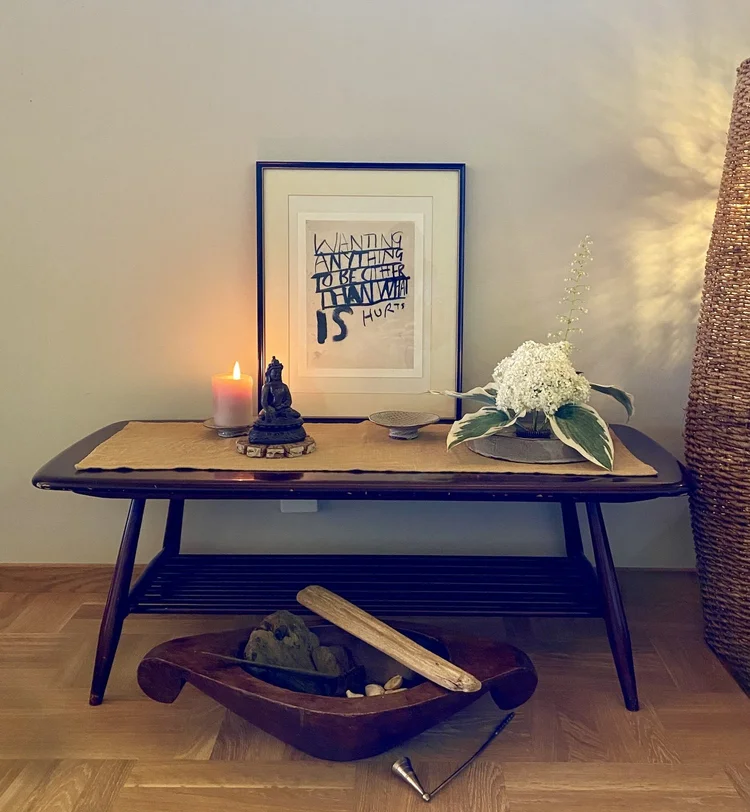
Dear Subscriber First Name,When I talk about the dharma, I avoid using most Sanskrit or Pali terms, the original languages of Buddhism. But there are words that have no equivalent in English, ‘dukkha’ is one of them. We often translate ‘dukkha’ as ‘suffering’. Would you say you’ve suffered today? Though many people could answer yes, hopefully not all of you, or at least not every day. Yet dukkha is a part of our everyday experience. It points to the entire range of experiences that we don’t want to have. From the tiniest itch on the back of my arm, right through to the immense pain of losing someone we love. It includes emotional distress, physical pain, sorrow, even boredom. Can you think of a word in English that would point to all of those experiences? So, if ‘dukkha’ isn’t already in your lexicon, it might be worth adding. Try saying it out loud to yourself, it even sounds like the experience it’s pointing to. Dukkha! But saying that the word dukkha points to all these experiences misses what dukkha actually is. The itch, the grief, the physical pain, these in themselves are not dukkha, they are only the occasions where dukkha can show up. The itch is unpleasant. Not to mention the grief. Yet even that experience of unpleasantness itself isn’t dukkha, it’s simply an unpleasant sensation, maybe an extremely unpleasant one. Dukkha only enters the stage when we resist those unpleasant sensations. Dukkha is the pain of wanting anything to be other that what isHere’s how it showed up in my life one evening:
I’d had a good day, work had gone well, there was a sense of flow. I’d just eaten a nice dinner. Then this mood descended on me, an odd feeling of emptiness or despair. It was unpleasant. I put on the TV to distract myself, but the mood continued. It was like a grey veil. If I thought of something in the future, I coloured it with this greyness, the same with the past. This unpleasantness seemed to be everywhere at once. But why? I searched my mind for something that was actually wrong and couldn’t find anything. Why should I feel this way? If there is nothing actually wrong and everything, just now, is pretty much okay, shouldn’t I feel okay? I should feel good, surely ‘good’ is the default setting unless something is ‘wrong’. I can’t let go of trying to figure out what is ‘wrong’. I go to the kitchen and as I’m filling the kettle I hear myself saying, “So you want to feel good all the time then?” It’s a straightforward question, not a judgement. The answer comes back, a clear “no”, “no, I don’t want to feel good all the time. I mean I don’t want to feel awful too much of the time, but I am happy to feel a whole range of feelings.” It was an odd realisation. At that moment I saw clearly how I didn’t want or need to feel good all the time, and yet, as soon as I don’t feel good I assume something is wrong! Do you like a romantic comedy, or a feel-good movie? Occasionally it’s just what I am in the mood for. How would you like to watch only romantic comedies, every day, nothing else? No thrillers, no tragedies, no screwball comedies, no serious documentaries. It would be awful. When I put on the TV or go to the movies, I want the whole emotional range, in its extremes. I want to feel it all. So why, in life, do I assume there’s something wrong in feeling anything other than good? This word ‘dukkha’, it’s not pointing to that vast range of possible human feelings. It’s pointing to the feeling that something is ‘wrong’ when we feel them. After his Awakening, the Buddha’s first teaching was on The Four Noble Truths:There is dukkha. The cause of dukkha is wanting and not wanting. It’s possible to end dukkha. There is a way of ending dukkha.
Does this brief list raise loads of questions for you? It does for me. What kind of pain is dukkha, and what is just a natural part of life? What am I doing to create more dukkha than is necessary? And how do I stop doing that? These aren't easy questions, and I don't think they're meant to be answered alone. Starting Friday, I'll be exploring exactly this on a home retreat with the Buddhist Centre Online — sitting with the question "how do we put an end to dukkha, and what would that even mean?" If any of this feels relevant to you right now, I'd love for you to join us.
|