The medicine we keep rediscovering
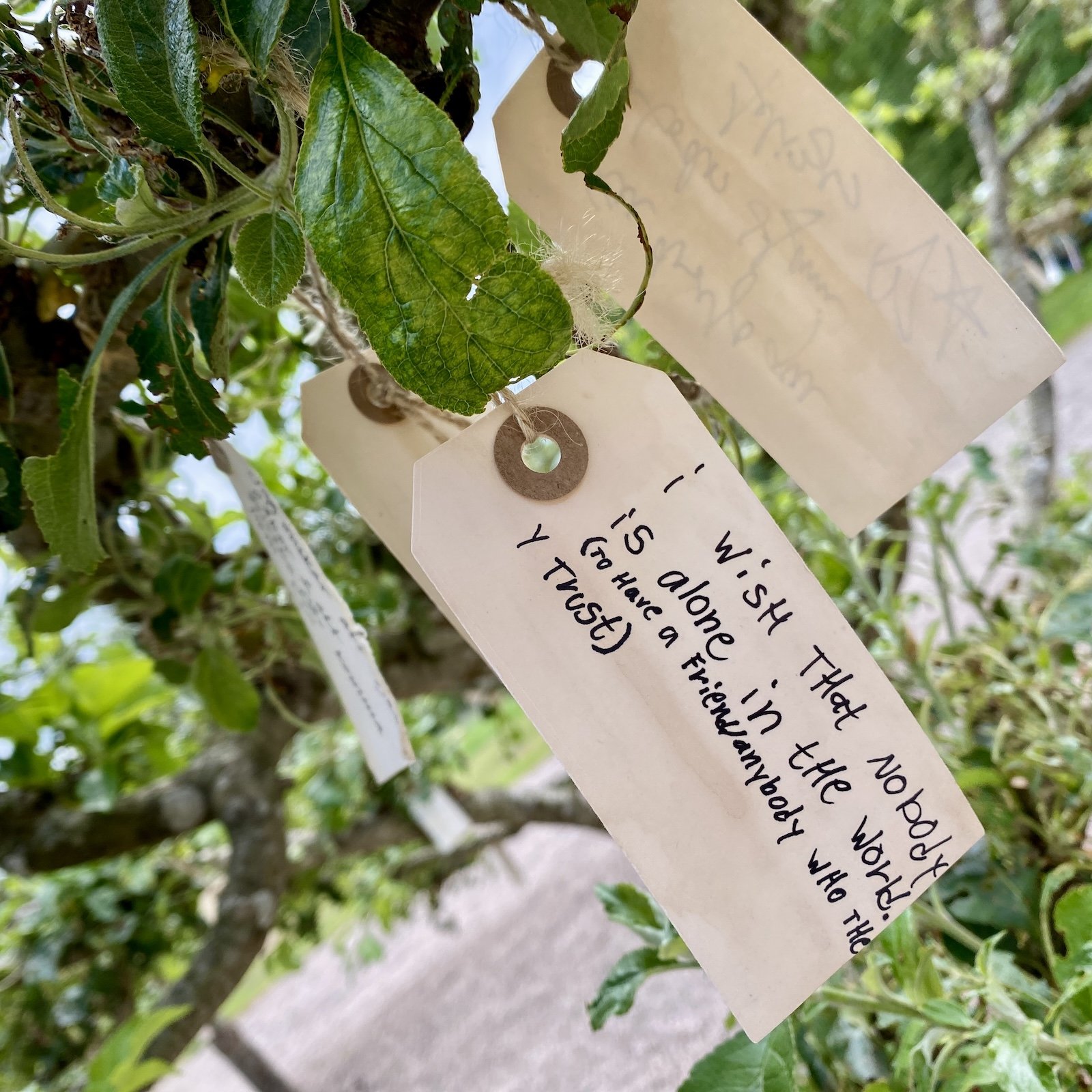
Yoko Ono’s Wishing Tree at Wanås Konst
What's your Dharma?
We each have an approach to practice that feels like our thing, and if you haven't figured out your thing yet, look at what you do, what you love, what resonates. My thing, when it comes to Dharma, is "the essentials."
I've been circling around some of the most essential teachings for decades: the skandhas, the lakshanas, the vimokshas, the fetters. My experience is that I can always dig deeper, find a more creative way of engaging, or relate the teaching to something else, often art, which shines a whole new light on it.
Recently it's been the Four Noble Truths, the theme of a few recent retreats, and there've been new discoveries, yes, even after knowing about them for nearly forty years! I thought I'd share four new realisations about the Four Noble Truths.
First Noble Truth — There is dukkha, suffering
Second Noble Truth — Dukkha has a cause: craving rooted in ignorance
Third Noble Truth — The cessation of dukkha is possible: awakening
Fourth Noble Truth — There is a path that leads to the end of dukkha
First Noble Truth:
The end of struggle, not the end of feeling.
What is this dukkha that the Buddha says we can put an end to? If I imagine a life with no suffering at all, just the bliss of some kind of Perfect Enlightenment, then I also imagine myself out of the picture. It sounds incredible, as in not really credible, and not relevant in any real sense. But what if the dukkha we can put an end to is "our struggle with the way things are"?
Struggle is my favourite translation of dukkha at the moment. What would happen if I put an end to struggle? I would still have a sore knee, still be sad that my friend got sick. There'd be headaches, grief, rain, disappointment, chipped mugs and so on, but there would be no struggle. There'd be no resistance to the headache, the rain, the grief, no reactions of wanting and not wanting. Instead there'd be a sensitivity to what is, a responsiveness.
Putting an end to dukkha is not putting an end to being human, but there'd be no more suffering from pain, suffering from sadness, suffering from grief. Is this what the Buddha meant when he said we could put an end to dukkha? Some imagine Enlightenment as being free of such feelings, but that gets way too abstract for me. I need a vision of awakening I can actually imagine, that motivates me to practice. Awakening as a life full of feeling but without struggle does that for me.
Second Noble Truth:
Don't Feed the Fire
The Buddha tells us that the cause of suffering is the kleshas, the poisons, the root ones being greed, hatred and ignorance. The teachings tell us we must destroy the kleshas. It's easy to get the impression that these poisons are somehow intrinsic to us, that they exist somewhere inside us, just waiting to ooze out. But what are they really?
They are not things so much as happenings. It's not that we are ignorant, or that there is something called ignorance that we have, but that we are in the habit of ignoring the way things are. We keep looking for permanence, substance and satisfaction and not finding them, yet we continue to search, expecting things and people to give us what they cannot. It's not that we have greed and hatred in us; we just find ourselves pushing some things away and grasping after others.
One way of "destroying" greed, hatred and ignorance is not to create them. It reminds me of the word Nirvana, which literally means "snuffing out," like putting out a fire. What comes to mind is how you can end a heated argument just by not reacting, or stay with feelings of boredom rather than reaching for your phone. We stop adding the fuel, and the fire goes out on its own. So if you want to destroy the poisons, just don't create them. Don't add fuel to the fires of greed, hatred and ignorance.
Third Noble Truth:
There Is Nothing to Attain
If the cause of dukkha is our wanting and not wanting, and underlying these is our ignoring of the way things are, our continuing to look for permanence, substance and satisfaction, then the Buddha's next teaching follows naturally: there is a cessation of dukkha. Dukkha ceases when we stop doing what causes dukkha. The responsibility really is on us, isn't it?
Notice that in this teaching, he doesn't say anything about developing or attaining. We just stop creating dukkha. What about developing compassion, fearlessness, clarity, generosity, equanimity? For me, underlying this teaching is the belief that these qualities are already in us*, hidden beneath the kleshas. Our job is to uncover them. This is the teaching of Buddha Nature. Some say it's implausible to think we already have all the qualities of the Buddha within us, but I think it's more implausible to believe we could develop them from nothing.
As I write this, there's been an earthquake in Venezuela, and heroic people are risking their own lives to help find survivors. I watch these people. They didn't develop compassion or fearlessness; these qualities are being drawn out of them by the situation. There is nothing to attain. We just have to stop creating anything that obstructs our own basic goodness. And when I find myself in tears watching them, it's because those qualities are in me too, however well hidden.
Fourth Noble Truth:
Test Everything, Trust Yourself, But Not Completely
It's said there are 84,000 teachings, a symbolic number. There are, therefore, many, many paths, and each of us needs to find our own, in the same way the Buddha did: through trial and error. He started out with a burning question: how do I find the medicine that puts an end to all suffering? He practiced with many teachers, attaining extraordinary states of mind, taking their teachings as far as they could go, and yet none of it answered his burning question. Each time, he walked away.
Unlike the Buddha, we can get stuck doing something that in our heart of hearts we know doesn't work. Something to look out for on the path is what's called the sunk cost fallacy, the idea that we're more likely to continue with a course of action if we've already invested a lot of time or effort in it, even when continuing isn't the best thing to do. Though the Buddha had invested heavily in these practices, and even gained great status within these communities, he still gave them up.
There's a conundrum here. We mustn't fall for the sunk cost fallacy and keep doing practices that aren't working, yet we also mustn't give up too soon, before we've wholeheartedly practiced something. The Buddha encouraged his disciples to test the teachings by putting them into practice, testing them against their own experience: do they lead to greater freedom? For me, it's important to trust my own experience. But not completely. So if I reject something as not working, traditional pujas, for example, aren't really my thing, I make a point of leaving the door open. Who knows, maybe the time just isn't right, or I'm not quite ready, for that particular medicine.
Four truths and four small shifts in how I understand them
Dukkha isn't the pain itself but our struggle against it. The poisons aren't inherent to us but fires we keep feeding, and we can simply stop adding fuel. Freedom isn't something to attain but something to uncover, already here, however hidden. And the way there isn't fixed; it's a medicine each of us has to test for ourselves.
So here's an invitation: pick one of these four reframes, whichever touched on something in you as you read, and carry it into this week. Notice where you're struggling rather than simply feeling. Notice where you're adding fuel. See the Buddha qualities already there in you, underneath the kleshas. The teachings are old, but the testing is always new, and it can only really happen in your own experience, right now.
* Note: Whether we are 'developing' qualities or 'discovering' them within us, I find it helpful to remember that these are both metaphors for what actually happens, which is something we cannot comprehend with our ordinary minds!
Related posts:
The meaning of dukkha
What is Nirvana?