What is qigong?
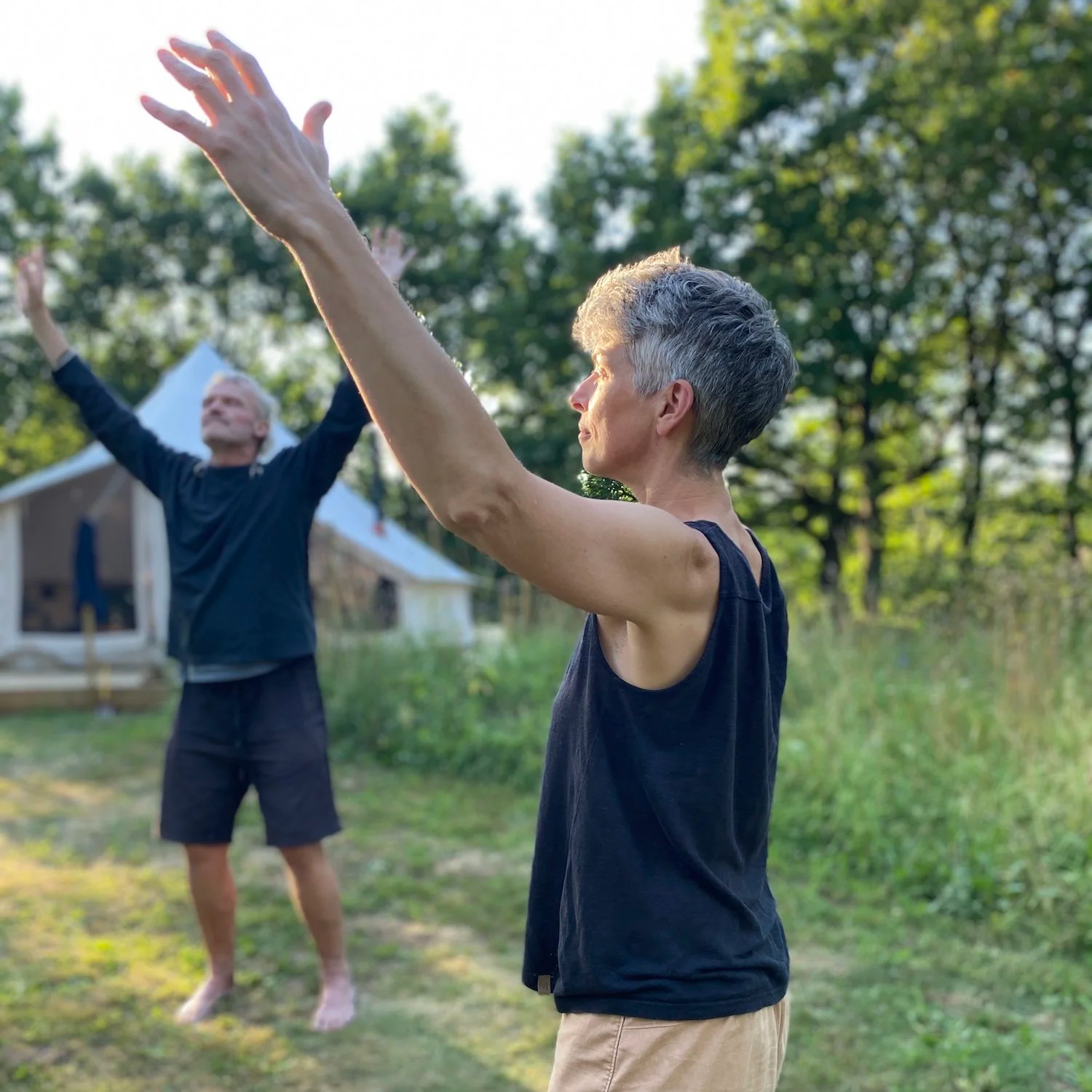
Qigong outside the meditation tent, Red Ladder Studio, Sweden
I've practiced qigong for a few years now, and like with a lot of things, the more I learn, the more it opens up — the vaster it gets. Like the Dharma, it's endlessly fascinating, never boring.
So what is qigong all about? In a nutshell, you could call it exercise for a healthy body and mind, rooted in Chinese Medicine. But you could equally call it movement meditation, or an embodied awareness practice. Qi translates as life force, life energy — that sort of thing we all know and feel but no one has ever found or held in their hand. Like gravity. Or sunshine. It's the vitality that flows through every living thing and makes it alive: human beings, animals, plants, rocks, atoms, cells. I like to call it “aliveness”.
Gong means work, or activity, or the benefit that comes from sustained practice. So in doing qigong, we are working with our life force, helping ourselves stay healthy, while at the same time exploring and connecting with that vast space of awareness, that unbounded aliveness we were never really separate from.
The basic thing about qi is that it wants to flow. Qi that flows freely, in and through our bodies, balances itself — like water that's free to move will find its own way, find its own level. When qi flows well, the nervous system settles, stress begins to loosen its grip and we feel more relaxed and alive.
Think of a dead body: there is no more qi, no more flow of life energy. Rigor mortis, the stiffening of the limbs, sets in when all energy has left the body, when everything has stopped and life is gone. So for life and health, we need a relaxed body — soft joints, soft muscles — a body where qi, blood and lymph can flow and move freely. Stagnant qi is like stagnant water: it turns impure, and can bring disease.
You could say qigong is like acupuncture without needles. Where an acupuncturist uses needles to open up areas of stuck energy, the movements of qigong open the body from within, releasing stagnation and inviting flow to return. You could also describe it as Chinese physiotherapy - a set of exercises that helps you loosen up joints, muscles and fascia.
Standing meditation is an important part of qigong practice — simply standing still, often with the arms held in a soft shape, letting the body settle into stillness while the qi moves. To me, this is a meditation form where it's easier to stay focused than in regular sitting practice. You keep attuning the posture — softening the knees a little more, releasing the shoulders, aligning the spine again — so the attention never really leaves the body. There's nowhere else for the mind to wander off to, because the body itself keeps calling it back.
Another beautiful thing about qigong is that it's so accessible, it can be practiced almost by anyone. You don't need any special clothes or equipment and although most exercises are designed for standing, with a little adaptation you can do qigong sitting or even lying down. For the couch sitter it's a gentle form of exercise, for the elite gymnast it's a form of releasing stress, increasing joint mobility and blood flow. For a Dharma practitioner it's another way into exploring direct experience and awareness, maybe discovering that it - qi/awareness - is already there and all we need to do is stop blocking the flow.
Think of a plant, or a tree. We're really no different. Just as a plant depends on the free movement of sap, on nourishment, on staying rooted in the earth, so do we depend on the free movement of our own life force to stay vital and healthy. The sap in the plant rises on its own, it simply flows because that's what life does when nothing is blocking its way. And the same goes for us - when our bodies relax and soften, when we let go of tightness and stuck energy, our life force can rise, flow and connect to the aliveness that is all around us.
Qigong is an invitation to remember this - in our own bodies: to relax and move and to let ourselves be moved.
Related posts:
Naked truths
No you, no tension